Performance management
Reviews your people can see coming, and grow from.
Goals and OKRs cascade into real learning paths. Review cycles arrive with the mastery evidence already attached. Calibration argues from data, and every 1:1 has talking points waiting.
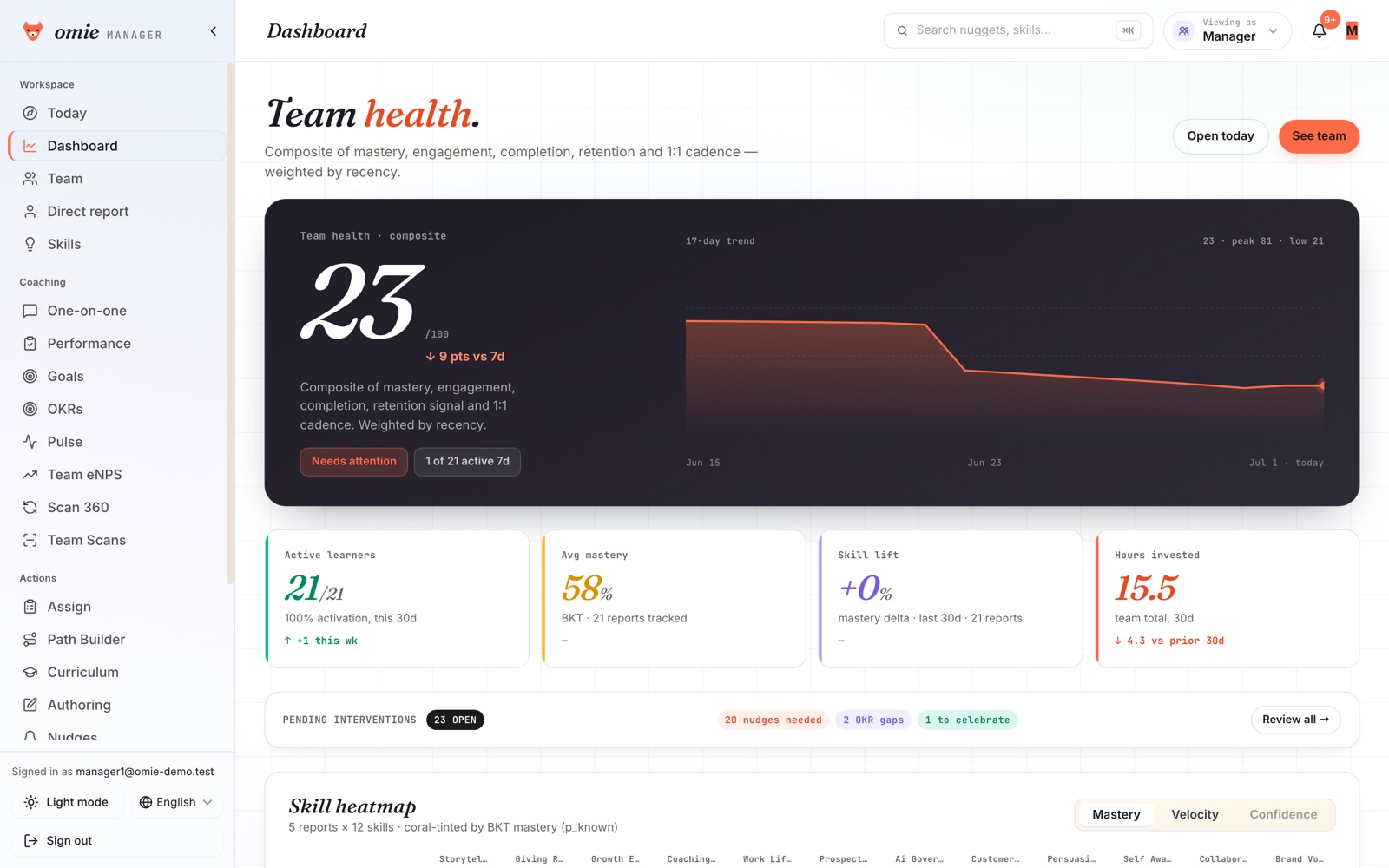
The develop half of performance is usually missing.
Most performance tools stop at the score. Omie is a learning platform underneath, so every review ends in a path, not a PDF.
Goals and OKRs
A cascade that ends in a path
Company objectives cascade to teams and people, and each personal goal links to the learning path that trains it. Progress is not a self-reported slider. It moves when mastery moves.
- Org to team to person. One cascade, visible end to end.
- Every goal gets a path. The develop plan is attached at set time, not invented at review time.
- Progress from evidence. Completions and mastery move the bar, not memory.
Review cycles
Self, peer and manager, with receipts
A cycle collects self reviews, peer voices and the manager summary in one dossier, and Omie attaches the year of evidence automatically: mastery deltas, finished paths, capstones, 1:1 notes. Nobody reconstructs a year from memory.
- The evidence dossier. Mastery, completions and capstones, gathered for you.
- Peer reviews built in. Colleagues contribute in app, not over email.
- Drafted summaries. Ada writes the first draft and cites its sources.
Run one cycle with the evidence attached.
Set goals this quarter, and by review time every conversation has receipts.
Included in Business, $15/seat/mo.
9-box calibration
Calibration that argues from data, not volume
The 9-box places people from performance and potential signals you can inspect, and every proposed move shows its evidence. The loudest manager stops winning, because the grid answers back.
- Placements you can audit. Every dot cites the signals that put it there.
- Moves with reasons. Promote, hold or support, each with the evidence behind it.
- Succession in view. Key-person risk and ready-now lists fall out of the same grid.
1:1s and check-ins
Every 1:1 arrives prepared
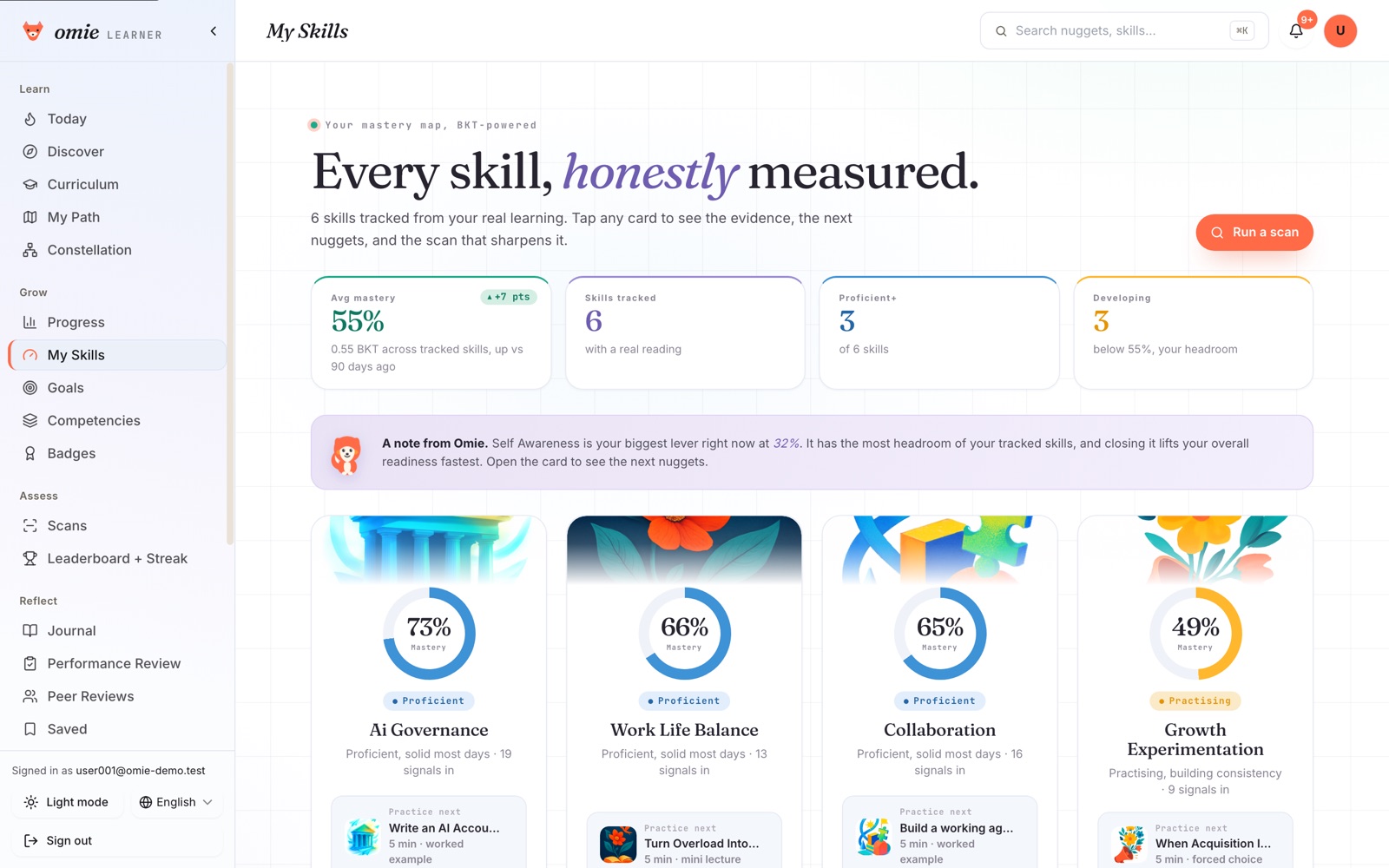
The team view keeps notes, agendas and signals per person, and Ada drafts talking points from what actually changed since last time. Check-ins stop being status theatre and start moving goals.
- Shared agendas and notes. One running thread per person, never lost.
- Drafted talking points. What changed, what stalled, what to say about it.
- Signals at a glance. Streaks, mastery and goal progress next to the notes.
Compliance
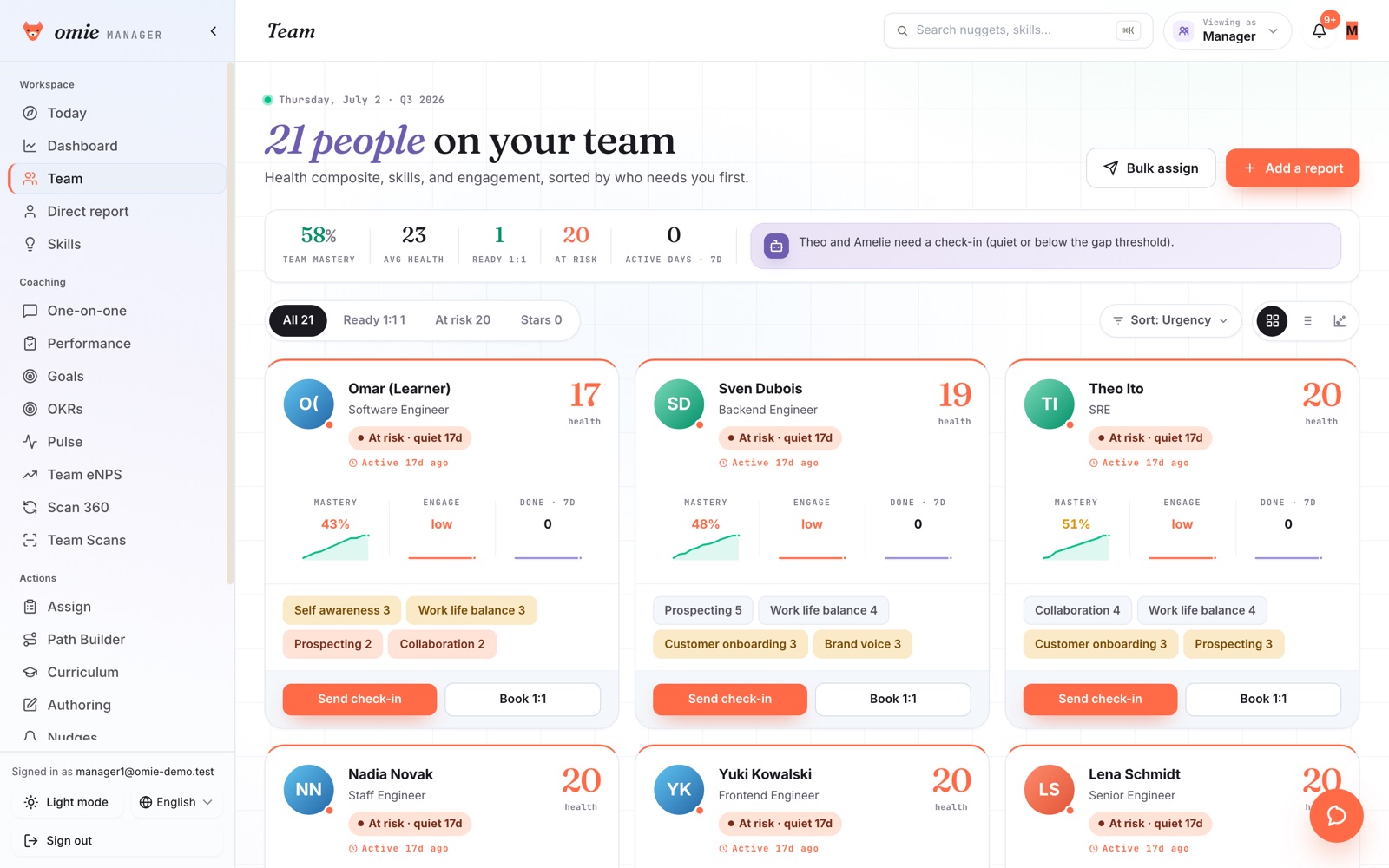
Compliance that closes itself
Assign mandatory training with due dates and the chase stops being your job. Reminders escalate on their own, completion rings fill on the same dashboard as everything else, and the export is audit-ready.
- Assign with deadlines. Policies and courses per role, team or everyone.
- Reminders that escalate. Nudges go out before due dates, managers see who is overdue.
- Audit-ready records. Completion evidence exportable when the auditor asks.
Programs and curriculum
Programs with stages, not one long list
Curriculum in Omie is a program: several tracks, staged with gates and cadence, assigned to a cohort. Onboarding, leadership programs and compliance curricula all run on the same board, with per-stage progress you can actually read.
- Multi-track programs. Stack tracks into a staged curriculum with gates between stages.
- Cohort progress. See a whole cohort move stage by stage, and who is stuck where.
- Reusable by design. Build the program once, run it for every new cohort.
The cycle, live
Watch one review cycle run end to end
Self review, peer voices, the manager summary, calibration, delivery. The same dossier travels through every stage, so nobody writes from memory and nothing gets invented at the end.
- Five stages, one dossier. Evidence follows the review instead of being pasted into it.
- Anonymized peer input. Peers answer in app, the summary keeps voices safe.
- Delivery ends in a path. The last step of a review is the next develop plan.
real stories
Real people. Real outcomes.
“We rolled out to 28 engineers. Onboarding ramp dropped from twelve weeks to six, and we have the L3 data to prove it.”
50%Faster ramp
“The lesson changes shape depending on how I learn. Some days a scenario, some days a quick audio on the walk home.”
61Lessons finished
“I get a Monday read on where my team really is, not vanity logins. It is the first L&D metric I forward to the board.”
L1-L4Rolled up
Illustrative voices from common situations, not named customers.
how it works
One cycle, four honest steps
From goals to delivered reviews without the archaeology.
Cascade goals
Company OKRs land as personal goals, each with a learning path attached.
Evidence accrues
Mastery, completions, capstones and 1:1 notes collect themselves all cycle.
Review with receipts
Self, peer and manager write against the same dossier.
Calibrate and deliver
The 9-box argues from data, and delivery ends in a develop path.
this is what you get
OKRs that get worked
OKRs tied to paths get worked weekly, not rediscovered at review time.
behind every rating
Promotions and ratings cite evidence a person can actually see.
ends in a path
Every cycle ends in a path, so the same gap does not return next year.
Reviews with the evidence attached.
“Sofia is ready for calibration: mastery up 12 points, capstone shipped. Here is the draft summary.”
Ada preps the 1:1, drafts the review, and cites the signals behind it.
Performance where the develop half exists.
Start free, cascade one team goal, and run your next cycle with the evidence attached.
Perform ships with Business, $15/seat/mo. Personal and Premium keep goals and 1:1s.
Ten modules. One brain. Interconnected.